ENERGY

One data layer for
the entire energy stack.

The energy transition runs on integration. Generation, storage, grid constraints, and consumption all need to talk to each other in real time. We build the platforms that make this possible. used in production by Build for Zero and Energy Data Xchange.

3 PILLARS
3+ yr
EDX in production
14k+
Companies on grid waitlists
18+
Zero-emission zones
THE TIPPING POINTS

Where the energy transition gets stuck

Across utilities, contractors, and asset owners, the same friction points block every project.

Grid constraints stop projects in their tracks

Connection waitlists are years long. Without simulation, every project gambles on whether the grid will be there.

Each integration is reinvented from scratch

Every new energy project rebuilds the same connectors. ESDL, weather APIs, meter data — all done over and over.

No common language between disciplines

Site planners, energy consultants, and grid operators each work in different tools with different data models.

Reporting is quarterly. Operations are real-time.

Compliance and sustainability reporting run on stale data while operational decisions need live signals.
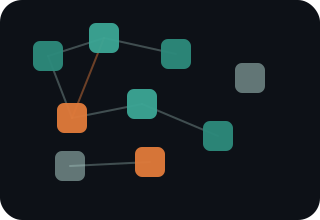

Productized illustration: grid
Productized illustration: data platform
WHO WE WORK WITH

Built for the people doing the energy transition

We partner with the technical leaders responsible for getting projects energised and running.

Energy ConsultantsSustainability DirectorsSite PlannersGrid EngineersAsset ManagersBIM CoordinatorsProject DirectorsHeads of InnovationCTOsOperations Directors
The real challenge

Stop reinventing the integration layer

Every energy project we see hits the same wall: the data model. Generation profiles, demand curves, grid topology, weather forecasts — each siloed in its own tool, each with its own format.

We built Energy Data Xchange to solve this once. A unified data layer with connectors for the systems the industry actually uses, an open ESDL-based model, and the simulation primitives that planners need. It has been running in production for over three years.

Build for Zero sits on top: a phase-driven simulation engine that takes a construction project from groundbreak to handover, modelling energy demand, generation, and grid impact at every step. Used by BAM, Heijmans, VolkerWessels, and Dura Vermeer.

The energy sector is in full swing, new innovations and solutions are everywhere. But the integration layer is still a mess. We needed a partner who understood that the software, data and AI all have to work together, not as separate point solutions.

Manager Energy Portfolio, BAM
OUR PILLARS

What we do.

Energy projects need software that ships, data that integrates, and AI that simulates. We work across all three.

SOFTWARE

Simulation & planning tools

Phase-driven simulation engines, scenario comparison, and decision-support apps for project teams.

Example

Build for Zero

A zero-emission construction planner used by the four largest Dutch contractors. From groundbreak to handover.

DATA

Energy data platform

A unified data layer for the energy stack: ESDL data model, connector library, time-series storage.

Example

Energy Data Xchange

A production data platform connecting energy producers, grid operators, and asset owners. Running 3+ years.

AI

Forecasting & optimisation

Mathematical optimisation for grid-constrained schedules, demand forecasting, and anomaly detection.

Example

Schedule Optimiser

Mixed-integer programming to fit zero-emission construction schedules within real grid constraints.

CASE STUDIES

In production

SOFTWARE + AI

Build for Zero

A zero-emission construction planner. Phase scheduling meets grid constraints meets mathematical optimisation.

DATA + PLATFORM

Energy Data Xchange

One data layer for the entire energy stack. ESDL-based, connector-driven, production for 3+ years. From source systems to operational decisions.

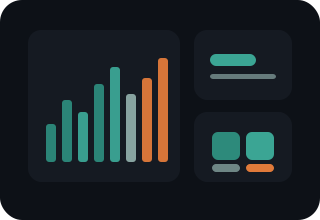
Productized illustration: dashboard
HOW WE WORK

Clarity. Build. Manage.

Every engagement follows three phases. We start by understanding, move to building, and stay to support.

01

Clarify

Map the landscape, define outcomes, design the approach.

02

Build

Iterative sprints with working demos every two weeks.

03

Manage

Production support, monitoring, and continuous improvement.

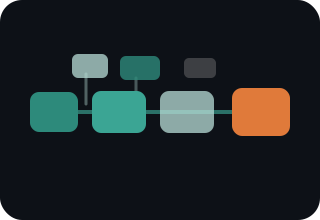
Productized illustration: flow
The energy stack, integrated

Start with clarity

Start with the layer that matters most for your team.

SOFTWARE

Simulate before you build

Phase-driven planning tools that account for grid constraints from day one.

DATA

Stop rebuilding integrations

A unified energy data platform with connectors for the systems you actually use.

AI

Optimise within real constraints

Forecasting and mathematical optimisation tuned for the energy transition.